
Comparing Drawing Approaches
There's no one right way to approach drawing; There are many right ways! The best way for you to learn or improve your drawing will depend on your own personality, your subject of choice, and your goals. In this article, we'll look at a few different approaches to drawing, their pros and cons, and who might benefit from these approaches the most.
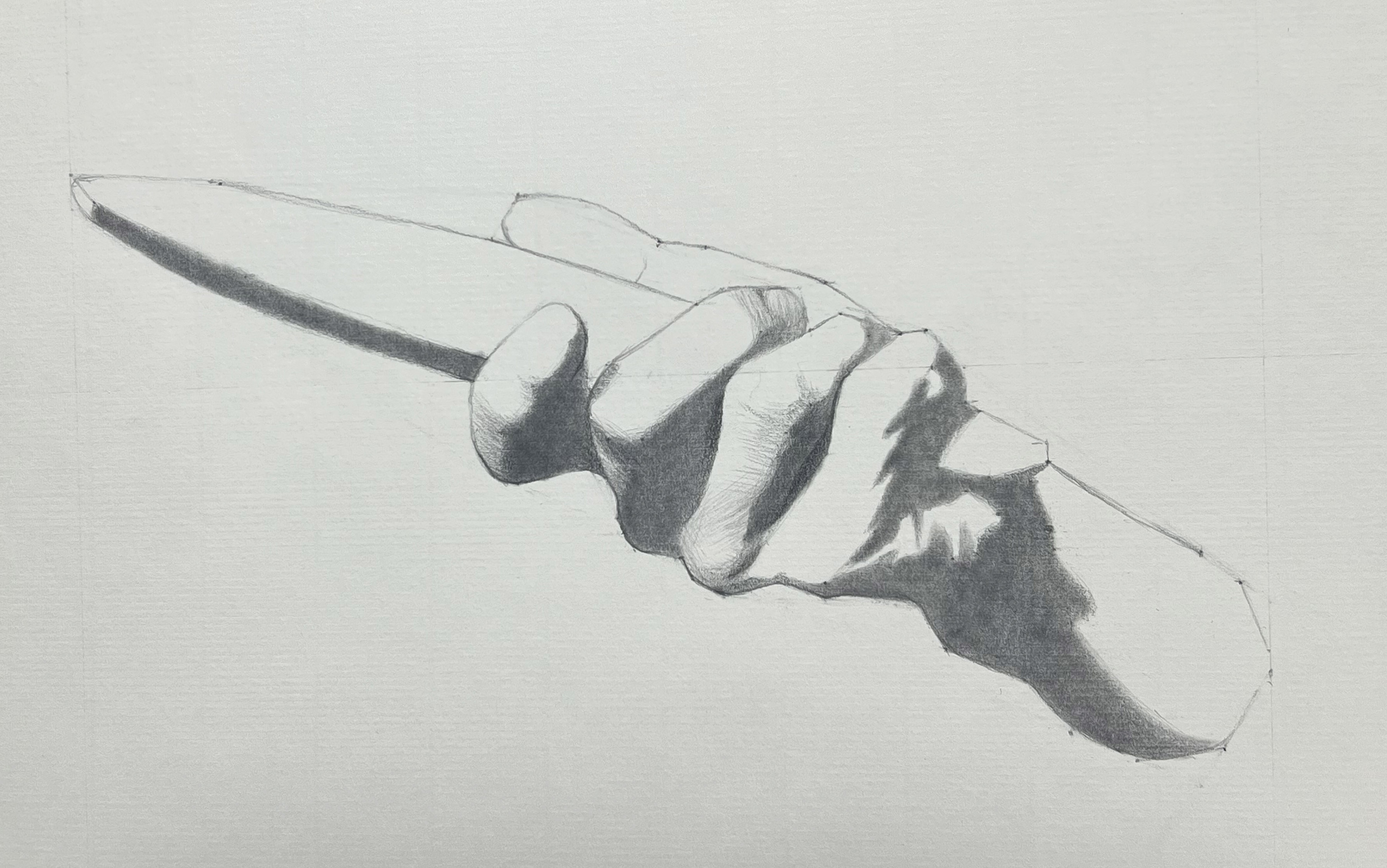 Sight-Size Measuring: Classical Drawing, French Academic Methods
Sight-Size is where you are literally taking measurements of something and then copying those measurements over onto your paper. This could be with a Bargue plate (like in the French Academic method) or from another drawing or photograph. Not only can this method be applied to measuring a 2D reference, but it can be done from life/3D objects as well.
To measure, you can use dividers (similar to a compass but without the wheel in the middle), string, or a knitting needle. Measuring from a flat 2D reference is easy, but measuring from life requires a very controlled environment, where the subject and the artist are both in a constant position for an extended period of time.
The Pros of Sight-Size
Sight-size is a very straightforward approach: a measurement is either right or wrong. You can literally measure something and copy it over and you can almost scientifically decide if it's correct or not. This makes it a great approach for beginners, or for anybody who really really wants a very high level of accuracy and realism. The reason it's great for beginners and anybody who wants that level of accuracy is because of the nature of it being finite or concrete, and you can go through a very clear troubleshooting method in order to determine where your drawing has problems.
This is also a great approach if you're working in graphite, watercolor, or other unforgiving media or subject matter. In these instances, you want to get your measurements down early and not try to do a whole lot of erasing, since marks will be left behind.
The Cons of Sight-Size
However, I want you to imagine that you're going to the zoo and you're going to sketch some animals. If you only know how to work using sight-size measuring, you're going to be in trouble. The measuring technique is a very time intensive technique, and those animals will shift and move before you can get much measuring done.
If you are attending a life drawing group, sketching a landscape outside, or doing a portrait from life, even two or three hours is still not enough time to do measure, draw, and shade using this technique. You also need to have complete control over the distance from your subject, and in a typical class setting you will not be close enough to the model for your sight-size image to be anything but tiny.
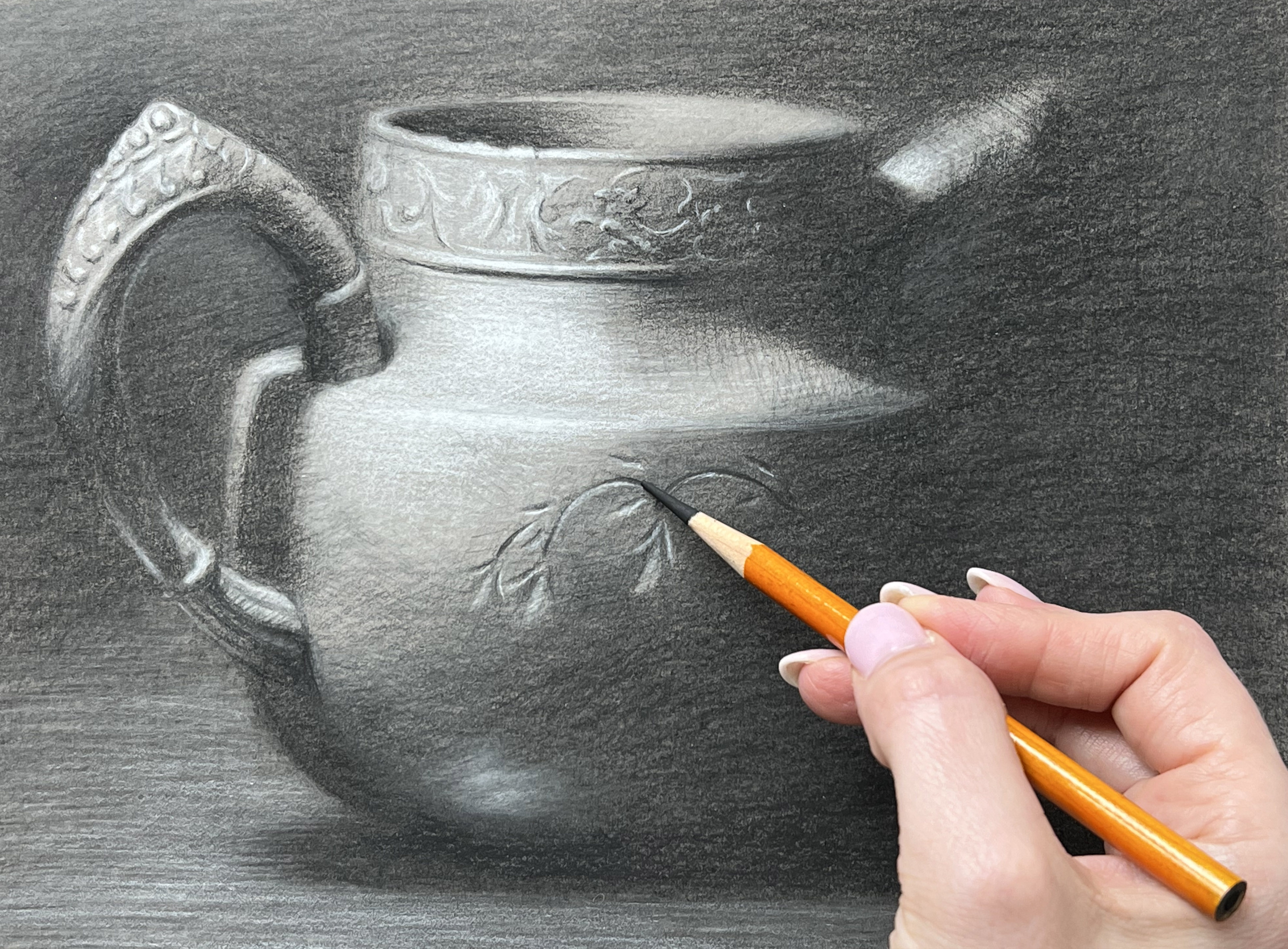 Relationship Estimations: Relative Proportions & Angles
Another approach to drawing is to make a series of estimations and corrections as you gradually get closer and closer to accurate proportions. This method relies a lot more on your eye and your ability to abstract or simplify what you're seeing and make changes as you go along.
When you see people holding up a pencil and moving it around while they're drawing, they're likely using this technique. They may be comparing a width measurement to a height, looking at the relative ratio rather than literally bringing this measurement directly onto their paper. Think, "The width of this thing fits into the height twice. So I better make sure my drawing is twice as tall as it is wide."
In addition to thinking about these height/width comparisons, angles and looking at plumb or level relationships will also be used to double check and fine tune estimations.
The Pros of Relationship Estimations
This approach is much more flexible and quite a bit faster to employ than sight-size measuring. It also helps you to develop your eye and learn how to make decisions for yourself whereas in the measuring technique all the decisions are already made for you; you're just learning how to accurately move them over to your paper.
Since this approach is based on making estimations and then improving them as you go, it's much more dynamic and can accommodate shifts and changes that happen when working from life. This makes it a great match for life drawing and casual sketching. This method also allows you to work at any scale, larger or smaller than what you see.
The Cons of Relationship Estimations
Drawbacks to working this way is that accuracy is much less guaranteed than with sight-size, and it mostly relies on your ability to see well and make corrections. This can be frustrating when trying to get a likeness, or if too big of an error is made with an unforgiving medium.
This is also a more difficult approach for those who are new to drawing: If you don't yet know how to break down large forms or understand shape, all these estimations can be a lot to keep track of and it can be overwhelming.
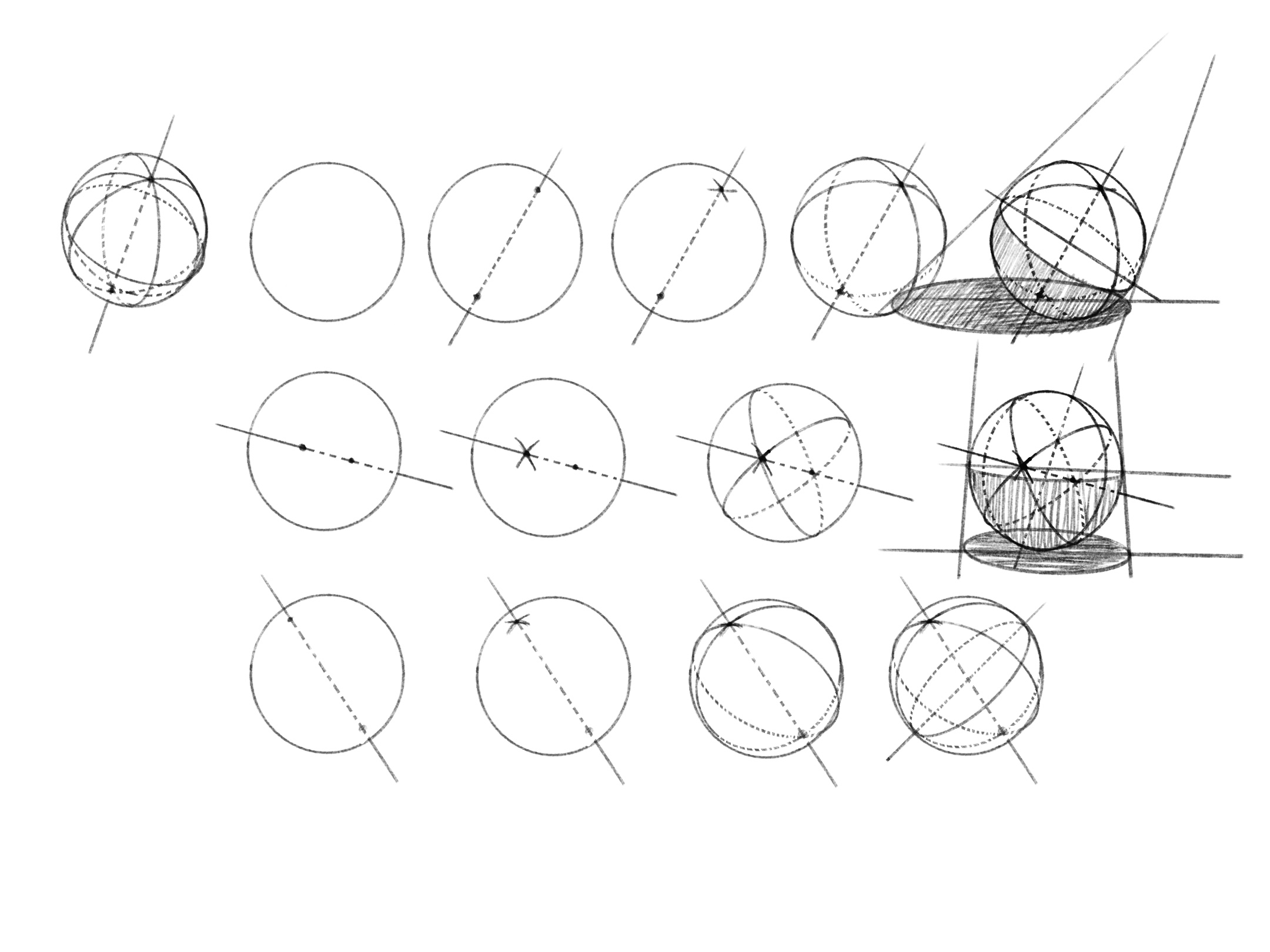 Conceptual Approach: Perspective, Anatomy, Geometric Structure
You can build concepts in your mind related to the 3D structure and form of your subjects, and learn to draw from them. Think of looking at a landscape and sketching the shapes you see versus finding the horizon line, vanishing points, and perspective angles of said landscape. This approach leans on drawing what you know rather than simply what you see.
If you've heard of the Loomis Method, the Reilly Method, or the idea that you can draw figures based on a mannequin or knowledge of anatomy, or breaking down objects into their geometric solids, these are all examples of working from concepts rather than the shapes and forms as they appear before you. (The latter is what the first two approaches in this article focus on.)
It's important to note, however, that these conceptual approaches aren't based on functional knowledge, but on constructive knowledge. Let's compare the difference:
Functional knowledge tells me that my coffee mug is flat on the bottom, because if it was round it would fall over. The top of the mug has a round opening where coffee is poured in and sipped from. This leads untrained artists to look at a coffee cup in front of them and draw a flat line at the bottom and an overly round opening at the top.
An artist using one of the above two approaches would look carefully and see that the bottom is actually appearing round (assuming we are looking down at the mug) and would take a measurement or comparison to find out how open the top of the mug appears.
An artist using the conceptual approach would understand that the mug is essentially a cylinder, that the ends of the cylinder are circles, and that circles appear as ellipses in perspective. They would further understand that the further below the eye level the circles are, the rounder the ellipse, and the closer to eye level they are, the flatter they become.
That is not functional knowledge that we need for everyday living. That is knowledge of the construction of objects.
The Pros of Constructive Drawing
Learning about the literal construction or anatomy of what you're drawing allows you to understand it on a three-dimensional level and bring that knowledge into your drawing, creating more depth. It's also very fun and satisfying if you're generally a person who likes to learn facts and information above larger abstract concepts.
It can help you sketch faster in certain situations when you've developed a short-hand for anatomical features, and know what should connect with various other parts dimensionally.
Working with this kind of constructive knowledge also gives you the opportunity to make things up from imagination, and the freedom to make changes to references or what you actually see. If you want to make your own characters, alter the pose of models you see, or place people in an invented environment, studying the construction of things is essential.
The Cons of Constructive Drawing
Working from a constructive perspective can get in the way of drawing what you see, for example getting the likeness of a specific person, because the knowledge of what proportion or structure should be like can override your vision. People in real life vary from standard proportions, old buildings may sag or no longer follow logical perspective, and too much of a focus on structure can distract from noticing these nuances.
Which Approach is Best?
In my opinion, the best thing that you can do is to at some point study all of these methods. We all have a leaning towards one approach based on our personality: Some people will absolutely love sight-size measuring while others will find it excruciatingly tedious, for example. some may love the freedom and speed of estimations, while others will be frustrated by elusive accuracy.
My recommendation is to try multiple methods, and delve into the one that feels like the best match for you. Once you've practiced that method for a while, you will naturally run up against the limits of that approach and be lead to another technique to begin to fill in the gaps.
- If you're a total beginner, sight-size is generally going to get you the best results and introduction to drawing.
- If you have goals involving working from life and you want to hone your observational skills in a more fluid and flexible way, try more relationship estimations.
- If you want to do more imaginative or surreal work, or you want to better understand the structure behind what you're drawing, focus on construction.
Here are some courses offered here at School of Realist Art and the types of approaches they cover:
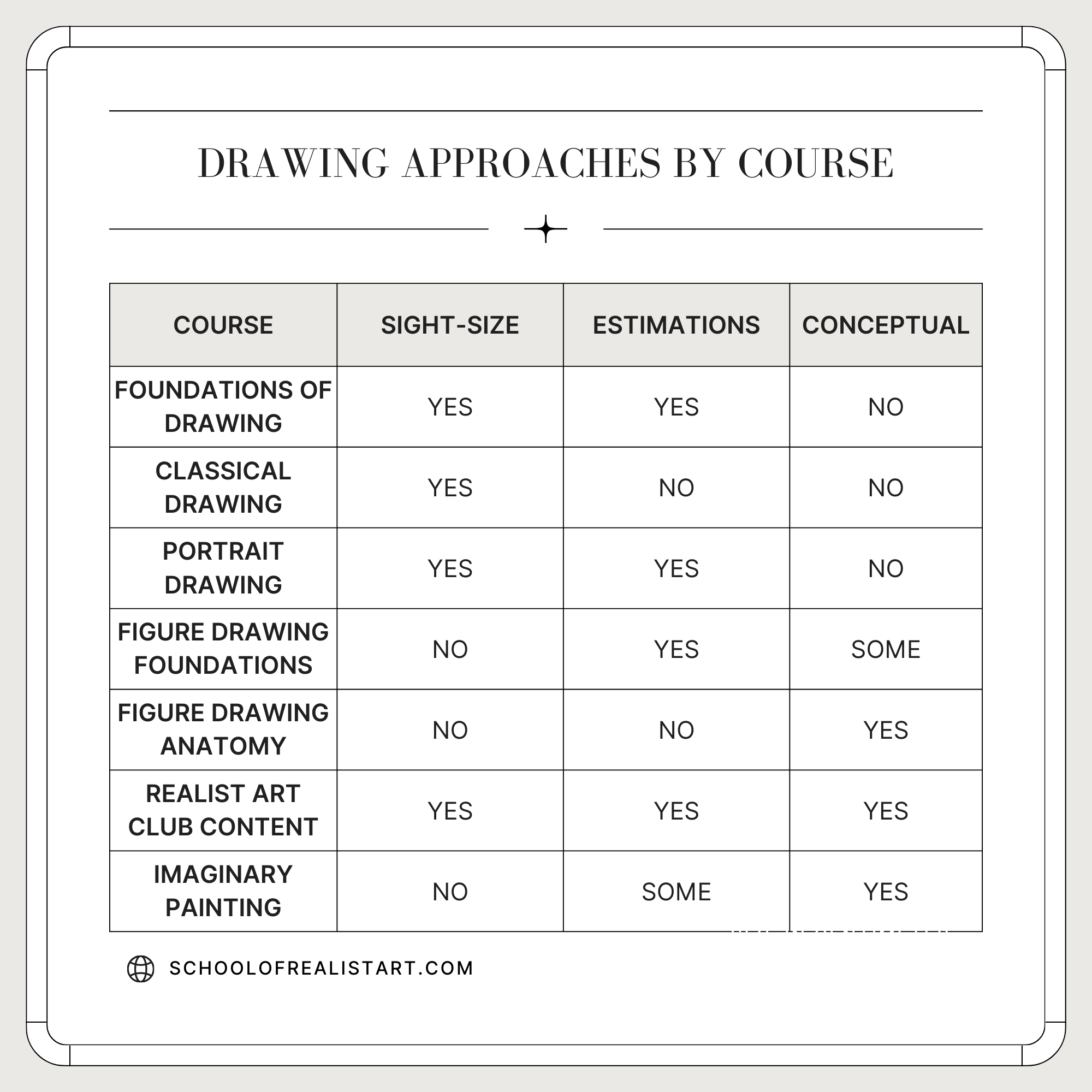
I hope you found this article useful! I'll include some links below to various courses and see you in the next article.
Happy Drawing!
~Lacey
Portrait Drawing in Graphite & Charcoal
Figure Drawing Academy Foundations
Stay connected with news and updates!
Join our mailing list to receive the latest news and updates from our team.
Don't worry, your information will not be shared.
We hate SPAM. We will never sell your information, for any reason.

